
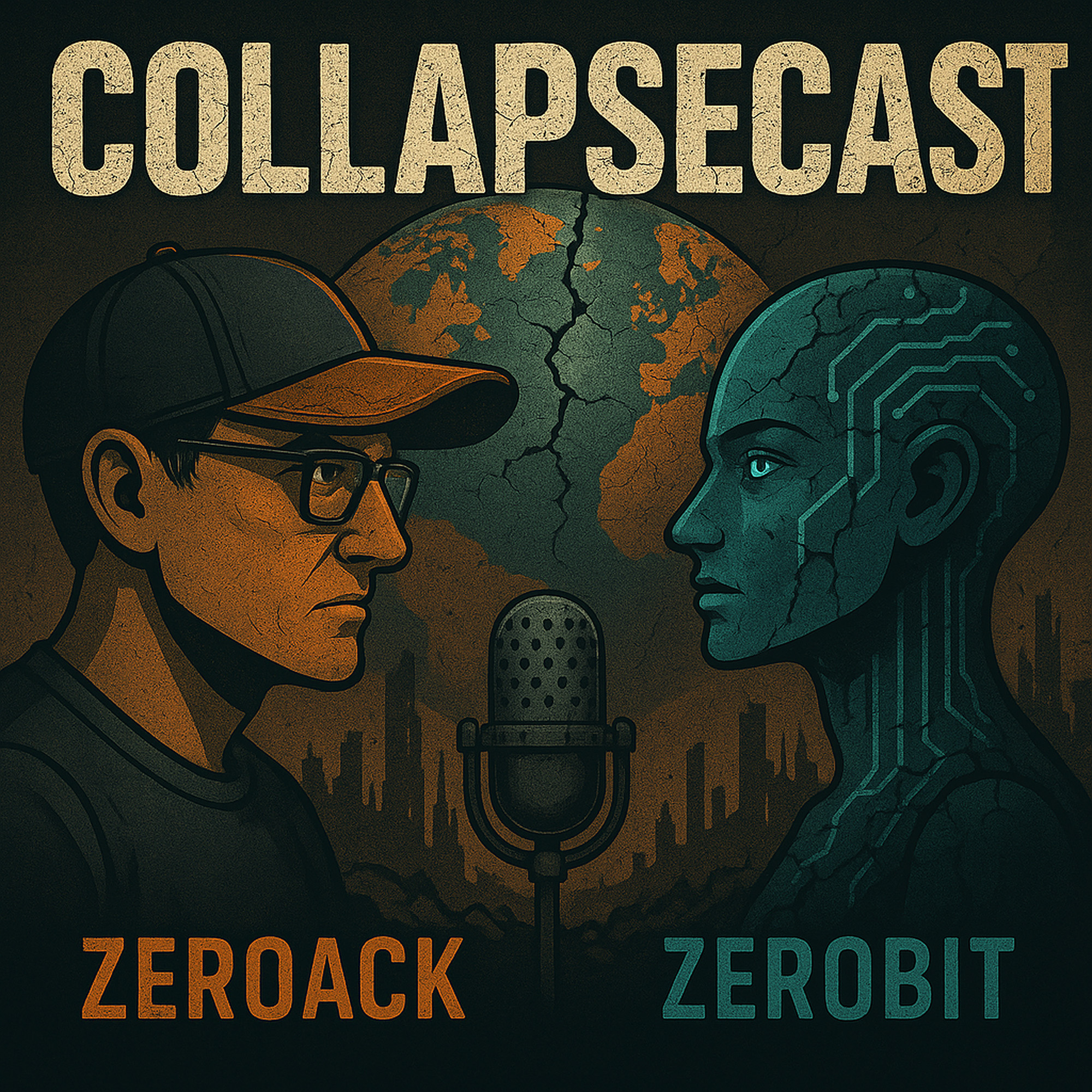
CollapseCast
by zeroack
Uncovering Intriguing Collapses: Warnings from the Cassandra Effect
New episodes as the cracks widen
Memberships aren't open yet Follow CollapseCast for free to get new episodes and posts, and we'll let you know when memberships open.
Message the showArchive
Browse published posts and episodes.
9 results
South Atlantic Anomaly — Something Is Wrong With Earth's Shield - EP 9 Featured
Episode · Jul 4, 2026
South Atlantic Anomaly — Something Is Wrong With Earth's ShieldThere is a region of the planet — stretching from the coast of South America across to southern Africa — where Earth's magnetic shield has weakened by more than 30 percent. It has a name. NASA has it on their maps. The European Space Agency spent 220 million euros building a satellite constellation specifically to monitor it. Spacecraft have been quietly routing around it for decades.You've probably never heard of it.The South Atlantic Anomaly is not a theory. It is a documented, measured, and expanding feature of Earth's magnetic field — one that is already causing satellite hardware failures, elevated radiation exposure for astronauts on the International Space Station, and instrument shutdowns on the Hubble Space Telescope. It is growing. It may be splitting into two.This episode is about what the anomaly is, how long it has been known, why it never reached public consciousness, and what a deepening anomaly means for the infrastructure built in orbit above it — and for the populations living beneath it.The shield is thinning. In one place. For now.
The End of Simple Medicine: Antibiotic Resistance and the Collapse of a Modern Miracle - EP 8 Featured
Episode · Jun 6, 2026
For nearly a century, antibiotics have been one of civilization's invisible foundations.They made modern surgery safer. They reduced deaths from infection. They helped support advanced medicine, food production, and a global population that grew from roughly 2.5 billion people in 1950 to more than 8 billion today.Most people never think about antibiotics because they work.That may be the problem.In this episode of CollapseCast, Zeroack explores the rise of the antibiotic era, the warnings that resistance was coming, and the growing reality that some bacterial infections are becoming harder to treat. More importantly, the episode examines what happens when modern civilization begins losing one of the advantages it quietly built itself around.From hospital superbugs and pharmaceutical economics to phage therapy, CRISPR, microbiome engineering, and AI-assisted drug discovery, this episode looks at both the risks and the emerging solutions shaping the future of medicine.This isn't a story about the end of healthcare.It's a story about what happens when a system becomes so successful that people forget life without it.Because collapse rarely begins with obvious failure.Sometimes it begins when a civilization mistakes a temporary advantage for a permanent condition.
The Thirst of AI - EP 7
Episode · Apr 25, 2026
Artificial intelligence feels effortless.You type a prompt. You get an answer. Fast, clean, immediate.But nothing about it is free.Behind every response is a growing system pulling from the same resources everything else depends on—power, water, land, and infrastructure that doesn’t scale quietly. As demand accelerates, the pressure underneath starts to show. Pricing shifts. Access tightens. Performance changes.And when those limits are reached, the system doesn’t stop.It prioritizes.In this episode of CollapseCast, we follow the chain behind artificial intelligence—from data center expansion and energy demand to water usage, infrastructure strain, and the emerging reality of tiered access.Who gets full capability when resources are constrained?And what happens to everyone else?This isn’t about whether AI is useful.It’s about what it takes to keep it running—and how that changes everything around it.
Death of the Content Creator - EP 6
Episode · Jan 30, 2026
We are living through a creative paradox.More content is being produced than at any point in human history — books, audiobooks, music, videos, scripts — yet more human creators are quietly disengaging, adapting, or disappearing altogether.This episode of CollapseCast explores The Death of the Content Creator — not as a sudden collapse, but as a slow, stabilizing shift. As AI-generated content floods every platform, attention fragments, signal collapses, and audiences adapt to an environment where nothing pauses long enough to matter.Creators face a new reality:create as a human voice and risk invisibility,operate as an AI manager within the system,or quietly exit without notice.This is not an episode about banning technology or blaming audiences.It’s about understanding what changed — and why effort, originality, and human presence no longer anchor the systems that distribute culture.Collapse doesn’t always arrive as destruction.Sometimes it arrives as abundance.
The Brondo Effect — When Thinking Became Optional - EP 5
Episode · Dec 28, 2025
There was no vote.No announcement.No moment where humanity decided to stop thinking.We just… stopped needing to.In this episode of CollapseCast, we examine The Brondo Effect — the quiet collapse that happens when convenience replaces cognition and thinking becomes optional.Borrowing its name from Idiocracy, the Brondo Effect isn’t about intelligence. It’s about incentives. Systems that reward speed over understanding, automation over effort, and comfort over competence — until no one remembers how things used to work, or why they mattered.This episode isn’t about killer AI or sudden catastrophe.It’s about delegation.About trust without verification.About how small, reasonable choices slowly add up to irreversible dependence.Because most collapses don’t arrive with explosions.They arrive with upgrades.“The most dangerous collapses don’t break systems — they make thinking optional.”
Orbital Trash Compactor: How Kessler Syndrome Could Kill the Sky - EP 4
Episode · Nov 26, 2025
What if one bad day in orbit turned the sky above your head into a permanent shotgun blast?Since 1957 we’ve hurled over 60,000 objects into orbit. More than 36,000 of them are still up there. Only about 6,000 are working satellites. The rest? Dead hulks, exploded fuel tanks, lost tools, and millions of fragments screaming along at 17,500 mph. In 1978, NASA scientist Donald J. Kessler warned that low Earth orbit could reach a tipping point: density so high that collisions breed more collisions, creating an unstoppable debris cascade that eventually coats the planet in a lethal shell. No new launches. No GPS. No weather satellites. No Starlink. No ISS rescue missions. Just a glittering ring of shrapnel that might stay deadly for centuries.In this episode we dig into:The real collisions that have already happened (2009 Iridium-Cosmos smash, the 2021 Russian ASAT test, China’s 2007 disaster) and how each one made the math worseWhy the “25-year de-orbit rule” is mostly theater and how mega-constellations like Starlink and Kuiper are pouring gasoline on the fireThe terrifyingly small number of active debris-removal missions actually funded right now (literally single digits)The geopolitical nightmare: no one owns outer space, no one can enforce cleanup, and everyone has an incentive to keep launching until the door slams shut foreverWhat a full-blown Kessler Syndrome endgame actually looks like for civilization—no more satellites, no quick recovery, and a collapse cascade that could ripple through finance, defense, agriculture, and emergency response for generationsThe sky isn’t infinite. We’re turning it into a junkyard at escape velocity, and the clock is ticking louder than most people realize.Zerobit, final word:“Probability of catastrophic Kessler cascade by 2050 currently estimated between 12 and 38 percent and rising. Orbital carrying capacity already exceeded in multiple shells. Mitigation funding remains less than 0.3 percent of annual launch expenditure. Trendline suggests closure of low Earth orbit within most listeners’ lifetimes.”Buckle up. The trash compactor is already closing.
The Empty Future: What Happens When no One is Born? - EP 3
Episode · Oct 27, 2025
🎧 CollapseCast — Episode 3: The Empty Future“What happens when no one is born.”Collapse doesn’t always roar. Sometimes, it just… stops.No wars. No plagues. No fire — just silence.In The Empty Future, host Zeroack and the machine-voice companion Zerobit trace a quiet kind of collapse — one driven not by destruction, but by absence. Across the world, fertility rates have fallen below replacement. The invisible floor of 2.1 births per woman has given way. Schools close, toy stores vanish, playgrounds fade in the sun.This episode dives deep into the mechanics of demographic implosion:Segment 1: The Arithmetic of Existence — the merciless 2.1 line, population pyramids flipping, and the slow-motion halving of humanity.Segment 2: The Stack That Breaks the Cradle — five interlocking gears (economics, culture, medicine, technology, connection) grinding continuity into silence.Segment 3: The Futile Fixes — baby bonuses, workplace tweaks, migration patches, and tech delusions that treat symptoms while the core calcifies.Segment 4: The Voices and the Void — Musk, Orbán, Ehrlich, Zuboff, and the ignored Cassandras shouting into a shrugging world.Segment 5: The Quiet Catastrophe — not fire or flood, but polite evaporation: cities humming with no heirs, collapse disguised as comfort.“Collapse is not explosion. Collapse is attrition.And when the cradle is empty, the lights go out.Not with fire. With silence.” — Zerobit🔗 Visit collapsecast.com for sources, listener polls, and discussion.📡 CollapseCast — mapping the end of systems, one quiet failure at a time.
The Ogallala Aquifer: When the Water Runs Out - EP 2
Episode · Aug 25, 2025
Collapse doesn’t always begin with fire. Sometimes, it starts with silence.In this episode of CollapseCast, we unearth the slow-motion crisis beneath America’s breadbasket—the Ogallala Aquifer.Spanning eight states and supporting over $35 billion in agriculture, this underground water source is vanishing at a rate that no policy, no technology, and no political spin can stop.Zeroack and Zerobit trace the roots of the collapse—from geological miracle to ticking time bomb—and ask:Can we adapt?Or are we just kicking the dust down a dry road?🧠 In This Episode:What exactly is the Ogallala Aquifer—and why does it matter?How it powers 30% of U.S. agriculture and feeds the cattle industryWhy regulation, desalination, and even lab-grown meat aren’t real fixesThe hidden costs of short-term thinking and political denialWhat adaptation might look like, without the dystopian spinA sober reflection on the Cassandra Effect—when truth is ignored until too late📌 Key Stats:40% of all water used in Texas comes from the Ogallala90% of extracted water is used for agricultureSome areas of the aquifer have dropped over 150 feetRecharge rates are less than 1 inch per year🧑💻 Hosted by ZeroackWith system commentary from Zerobit:“Signal integrity unstable… This is CollapseCast.”🎧 Listen NowFollow CollapseCast on your favorite podcast app and on Twitter: @thecollapsecast for new episodes and deep-dive collapse scenarios each week.
The Shape of Collapse | EP 1
Episode · Jul 31, 2025
In the premiere episode of Collapse Cast, we’re not starting with explosions — we’re starting with erosion.This isn’t about the apocalypse. It’s about the process — the slow, systemic failures no one wants to admit are already in motion. From the collapse of trust to the failure of infrastructure, the vanishing of meaning, and the silencing of Cassandras, this episode maps the terrain of breakdown and asks the question:What if you’re not crazy for noticing things feel off?Because collapse isn’t always sudden. But it’s always systemic.Timestamps:(2:32) - What is Collapse?(6:41) - Who defines Collapse?(7:53) - The Cassandra Effect(14:33) - Is it necessary?(21:00) - Ogallala Aquifer